 العربية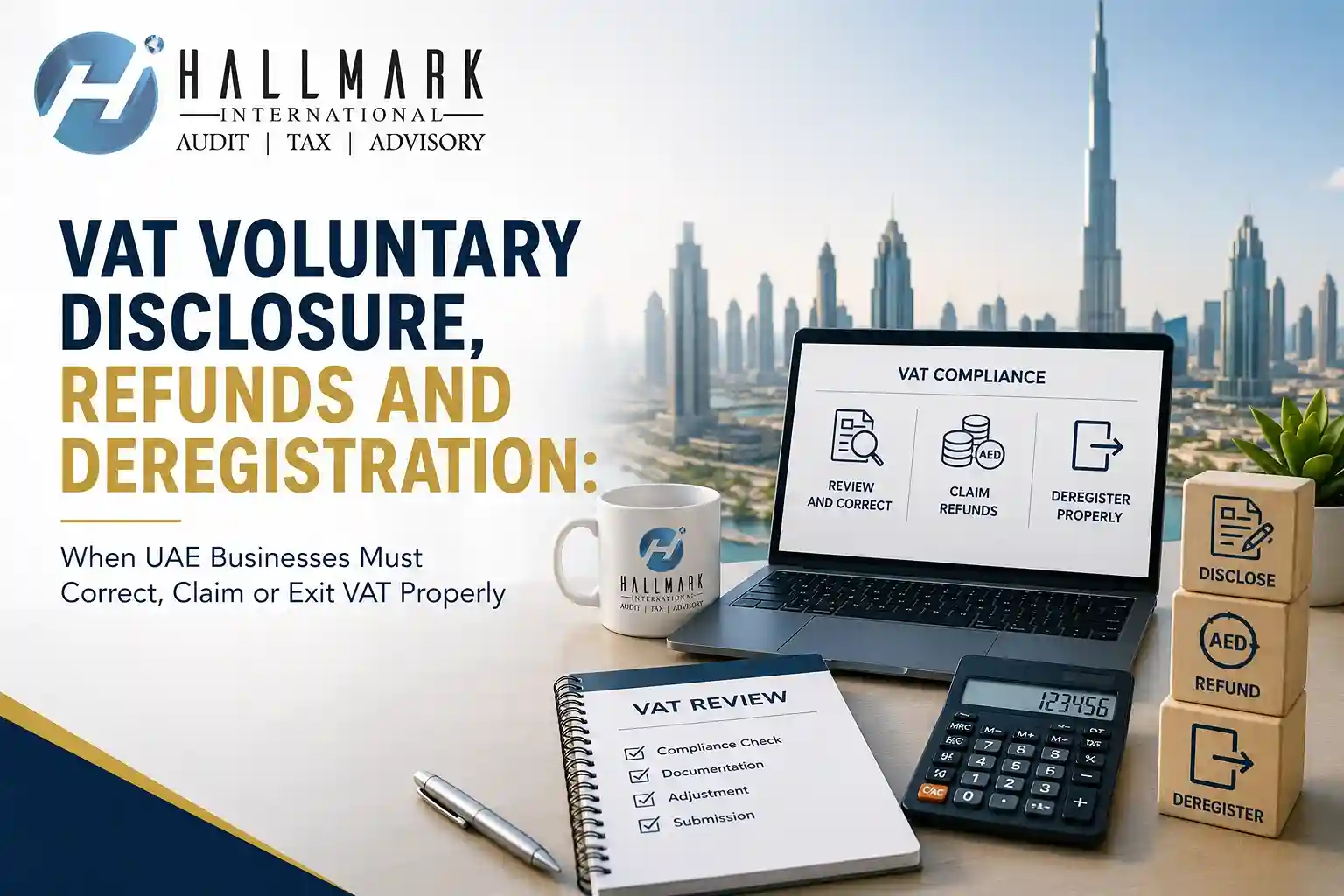
Even well-managed businesses can discover VAT errors after filing returns. The key question is not whether an error happened. The key question is how quickly and properly the business corrects it.
The UAE VAT system allows taxpayers to correct certain errors through the voluntary disclosure process. Businesses may also become eligible for VAT refunds when recoverable input VAT exceeds output VAT liabilities. At the same time, some businesses may need to deregister when they no longer meet VAT registration conditions.
When Is VAT Voluntary Disclosure Required?
A voluntary disclosure may be required when a business identifies incorrect VAT returns, incorrect tax assessments, understated payable VAT, overstated refunds or other material VAT errors.
Common Voluntary Disclosure Scenarios
- Understated payable VAT: the actual VAT liability exceeds the amount reported.
- Overstated payable VAT: more VAT is reported than actually due.
- Understated refund: the taxpayer claims less refund than entitled.
- Overstated refund: the taxpayer claims more refund than entitled.
- Incorrect VAT return classification, missed transactions or wrongly claimed input VAT.
Benefits of Timely Disclosure
- Demonstrates responsible compliance behaviour.
- Reduces regulatory risk.
- Helps mitigate penalty exposure.
- Maintains accurate tax records.
- Allows management to understand and correct process weaknesses.
VAT Refunds: A Credit Balance Is Not Enough
A business may become eligible for a VAT refund when recoverable input VAT exceeds output VAT liabilities. This commonly happens in export-oriented businesses, businesses making large capital investments, start-up operations and entities with excess input tax accumulation.
When Refunds Commonly Arise
- Export-oriented businesses with zero-rated sales.
- Businesses making large capital investments.
- Start-up operations before full revenue generation.
- Businesses with excess input tax accumulation.
Refund Application Process and Practical Controls
The taxpayer may apply to the FTA for a refund of the credit balance, subject to regulatory requirements. Before applying, the business should maintain complete documentation, ensure proper VAT coding, reconcile balances before submission and monitor application timelines.
Refund claims are stronger when the business can clearly support the relationship between invoices, payments, customs records, zero-rated sales and VAT return balances.
VAT Deregistration: Do Not Ignore the Exit Requirement
Businesses may be required to deregister for VAT under certain circumstances. Mandatory deregistration may apply when business activities cease, taxable supplies stop or revenue falls below prescribed thresholds. Voluntary deregistration may also be possible if the business meets the relevant criteria under UAE VAT legislation.
Risks of Not Deregistering When Required
- Administrative penalties.
- Continued compliance obligations.
- Additional regulatory scrutiny.
- Unnecessary filing burden for inactive or non-qualifying businesses.
| Practical point: VAT compliance includes knowing when to correct an error, when to claim a refund and when to deregister. |
If your business has VAT credits, past return errors or inactive VAT registration, Hallmark Auditors can review whether voluntary disclosure, refund application or deregistration action is required.