 العربية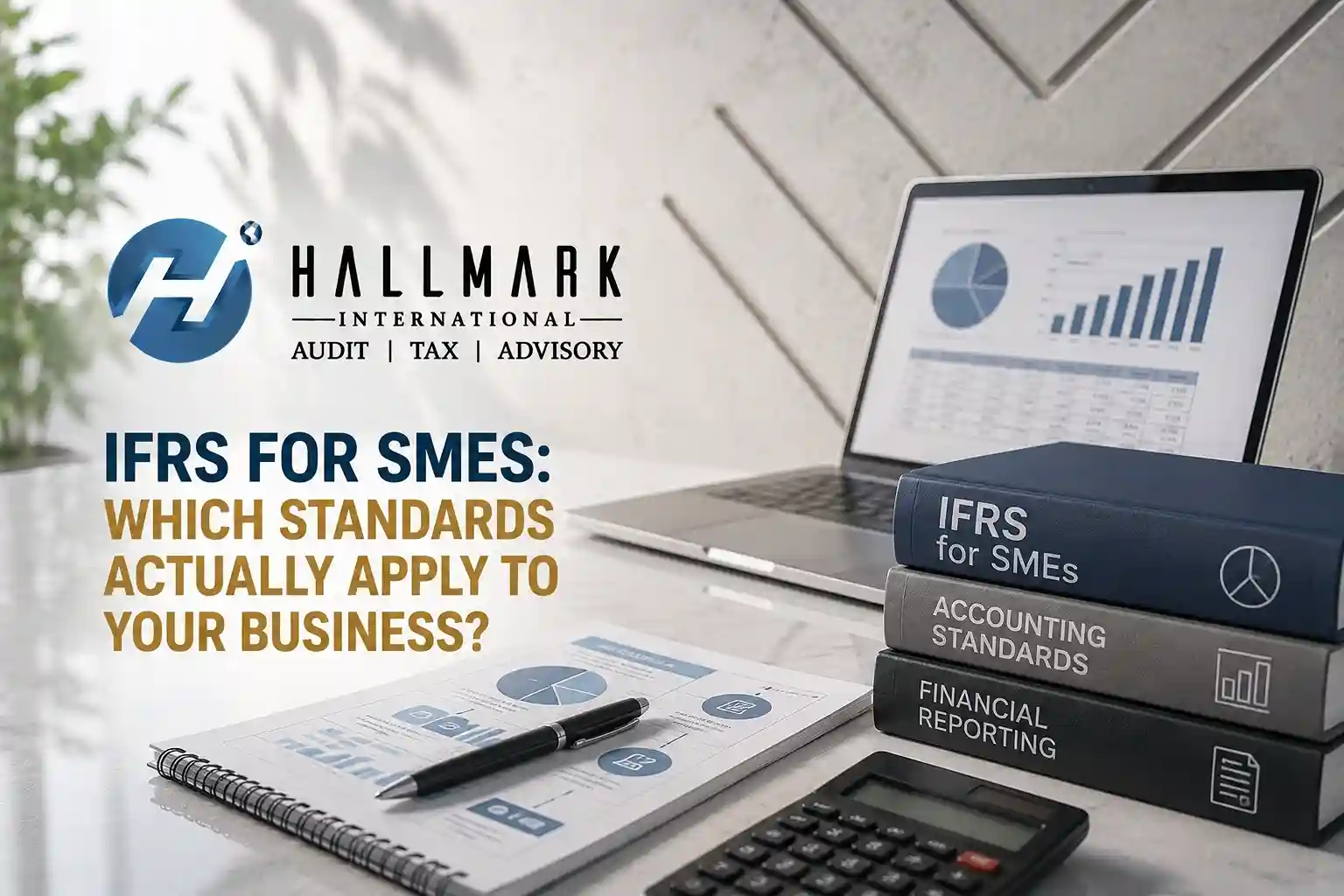
For many small and medium-sized businesses (SMEs), accounting standards can feel like a maze of technical jargon, lengthy documents, and rules that seem designed for large multinational corporations rather than privately owned businesses.
The good news is that you don’t need to master every accounting standard. If your business prepares its financial statements under IFRS for SMEs, only certain sections are likely to apply to your day-to-day operations. Understanding those key areas can make financial reporting significantly simpler, help you stay compliant, and give you greater confidence in your business’s financial information.
Whether you’re preparing your company’s first IFRS-compliant financial statements or looking to improve reporting accuracy, working with experienced accounting outsourcing companies in Dubai can simplify the process.
What Is IFRS for SMEs?
The International Financial Reporting Standard (IFRS) for Small and Medium-sized Entities (SMEs) is a simplified accounting framework developed specifically for privately owned businesses that do not have public accountability.
Unlike full IFRS, which is primarily intended for listed companies and large public-interest entities, IFRS for SMEs removes many of the more complex accounting requirements that smaller businesses rarely encounter. The objective is straightforward: to help SMEs prepare reliable financial statements without the unnecessary complexity of full IFRS.
Think of it as a practical version of international accounting standards designed for growing businesses rather than global corporations.
Does Every Standard Apply to Your Business?
This is perhaps the biggest misconception surrounding IFRS for SMEs.
No, not every section applies to every business. Many business owners assume they must understand every accounting requirement before they can prepare compliant financial statements. In reality, most SMEs regularly use only a relatively small number of the standards.
The sections that apply depend entirely on the nature of your business. For example:
- A retail business is likely to focus on inventory, revenue, and fixed assets.
- A consulting firm may rarely deal with inventory but will regularly account for revenue, employee costs, and receivables.
- A family-owned manufacturing company may need guidance on machinery, borrowing costs, and inventory valuation.
- A start-up with straightforward operations may only apply a handful of sections during its early years.
Rather than asking, “How do I learn every standard?”, a better question is: “Which standards are relevant to the way my business operates?”
The Standards Most SMEs Use Regularly
Although IFRS for SMEs contains multiple sections, most privately owned businesses consistently rely on the following areas.
1. Financial Statements
Every business preparing financial statements under IFRS for SMEs needs to present:
- Statement of Financial Position (Balance Sheet)
- Statement of Profit or Loss
- Statement of Changes in Equity
- Statement of Cash Flows
- Notes to the Financial Statements
These reports provide stakeholders with a clear picture of the company’s financial performance and position. Businesses that need assistance preparing IFRS-compliant financial statements can benefit from professional bookkeeping outsourcing services, ensuring reports remain accurate, audit-ready, and fully compliant throughout the year.
2. Revenue
If your business sells products or provides services, revenue recognition is one of the most important accounting areas. Revenue should generally be recognised when your business has earned it not simply when payment is received.
For example:
- Goods have been delivered.
- Services have been completed.
- Your contractual obligations have been fulfilled.
Getting revenue recognition right ensures that profits are reported accurately and consistently.
3. Property, Plant and Equipment
Almost every business owns assets such as:
- Computers
- Office furniture
- Machinery
- Vehicles
- Buildings
These assets are recorded at cost and gradually expensed over their useful life through depreciation. Properly accounting for fixed assets helps ensure the financial statements reflect their true value over time.
4. Inventory
If your business buys, manufactures, or sells products, inventory accounting is essential. Inventory should generally be valued at the lower of:
- Cost, or
- Net realisable value (the estimated selling price less any costs to complete or sell the item).
Using consistent valuation methods prevents profits from being overstated and provides more reliable financial information.
5. Money Owed by Customers
Customers do not always pay on time and occasionally, they may not pay at all. IFRS for SMEs requires businesses to assess whether outstanding customer balances are likely to be collected.
If recovery appears unlikely, the business should recognise an expected loss rather than waiting until the debt becomes completely unrecoverable. This results in financial statements that present a more realistic picture of the business.
6. Loans and Borrowings
If your business has:
- Bank loans
- Vehicle finance
- Equipment financing
- Overdraft facilities
These should be recorded appropriately, with interest recognised over the life of the borrowing. Fortunately, the accounting requirements are significantly simpler than those under full IFRS.
7. Income Taxes
Every profitable business has tax obligations. Under IFRS for SMEs, businesses should account for:
- Current tax payable
- Deferred tax, where applicable
Although deferred tax can appear technical, the simplified framework makes it more manageable than under full IFRS.
8. Employee Benefits
If you employ staff, this section applies to you. Employee-related costs include:
- Salaries
- Bonuses
- Annual leave
- End-of-service benefits
- Pension obligations, where applicable
These costs should be recognised as employees earn them rather than only when payments are made.
9. Related Party Transactions
If your business enters into transactions with:
- Directors
- Shareholders
- Family members
- Parent companies
- Subsidiaries
certain disclosures may be required.
These disclosures improve transparency and help users understand the nature of significant business relationships.
Which Standards Might Not Apply?
This is where many businesses become unnecessarily concerned.
Depending on the size and complexity of your operations, there may be entire sections of IFRS for SMEs that you never need to apply. Examples include:
- Business combinations and acquisitions
- Share-based payment arrangements
- Foreign currency operations
- Investments in associates or joint ventures
- Consolidated financial statements
- Specialised financial instruments
If your business operates from one country, has straightforward ownership, and carries out relatively simple transactions, these areas may not be relevant. Understanding this can save business owners countless hours trying to interpret accounting guidance that simply does not apply to them.
A Simple Way to Know What Matters
Instead of trying to memorise every section of IFRS for SMEs, think about the activities your business carries out every day.
| If your business… | Then these areas are likely to matter |
| Sells products | Revenue and Inventory |
| Provides services | Revenue and Receivables |
| Owns equipment | Property, Plant and Equipment |
| Employs staff | Employee Benefits |
| Has bank loans | Financial Instruments |
| Pays taxes | Income Taxes |
| Deals with related companies or owners | Related Party Disclosure |
This simple approach makes it much easier to identify which parts of IFRS for SMEs deserve your attention.
Common Misconceptions
“We’re a small business, so accounting standards don’t apply to us.”
Many SMEs are required to prepare financial statements in accordance with an applicable reporting framework. Good financial reporting is not just about compliance it also supports better business decisions.
“IFRS for SMEs is just a shorter version of full IFRS.”
Not quite. It is a standalone framework specifically designed for SMEs. While it is based on the same accounting principles as full IFRS, many recognition, measurement, and disclosure requirements have been simplified.
“I need to understand every section.”
Most businesses do not. In practice, many SMEs regularly use only the sections that relate to their everyday transactions.
Why Understanding the Right Standards Matters
Applying the right accounting standards in UAE is about much more than meeting regulatory requirements. Reliable financial statements can help your business:
- Improve financial decision-making.
- Secure financing from banks and lenders.
- Build confidence with investors.
- Support statutory audits.
- Demonstrate transparency to shareholders and stakeholders.
- Reduce costly accounting errors.
By focusing on the standards that genuinely apply to your business, you can spend less time navigating technical guidance and more time growing your business. Achieving these benefits becomes significantly easier when your financial records are maintained by experienced audit services companies.
Conclusion
IFRS for SMEs was developed to simplify financial reporting not to make it more complicated. The key is recognising that not every section applies to every business.
Most SMEs regularly deal with a core group of standards covering areas such as revenue, inventory, fixed assets, taxes, employee benefits, and financial statement presentation. Understanding these key requirements allows business owners to approach financial reporting with greater confidence while avoiding unnecessary complexity.
At Hallmark International Auditors, we believe accounting standards should empower businesses rather than overwhelm them. By helping our clients understand the requirements that truly matter, we make financial reporting more practical, more efficient, and better aligned with the needs of growing businesses.